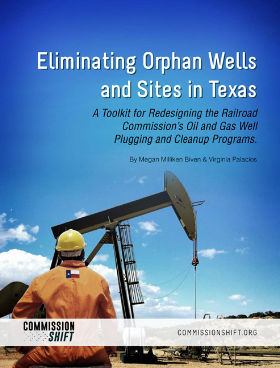
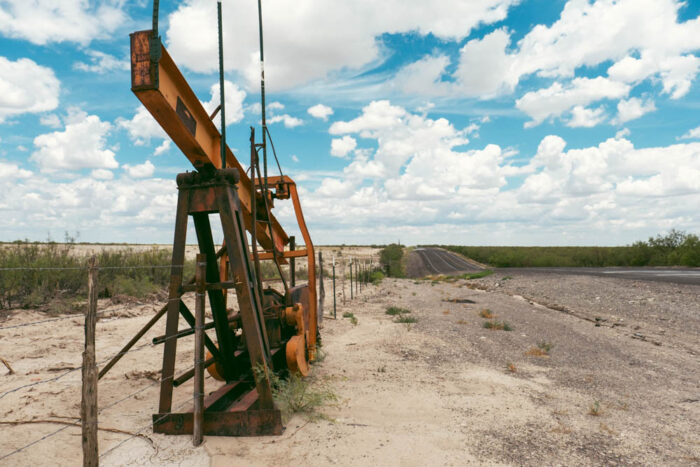
At the April 14th Open Meeting of the Railroad Commission of Texas, Commission Shift Executive Director Virginia Palacios spoke about how important it is for the Railroad Commission to prioritize allowing impacted communities to provide public input.
View a written copy of Virginia Palacios’s public comments here.
The Railroad Commission (RRC) permits, monitors, and enforces rules for all Texas oil and gas development. RRC decisions are critical to public health and climate emissions, yet the agency operates with little public accountability. For instance, the three elected Commissioners have deep financial ties to the industry they regulate, with two-thirds of their campaign contributions coming from oil and gas.
The RRC holds monthly open meetings. While challenging to follow, the open meetings are a valuable opportunity to get issues on the record and learn more about decisions that affect us and our communities.
The open meeting agenda for April 14, 2026 at 9:30 AM is available.
Below are our agenda highlights with some additional notes and context.
Items 3 – 8: Six operators will lose their P-5’s as a result of their failure to plug their inactive wells, file for plugging extensions, or file paperwork indicating that cleanup was completed on their site (Statewide Rule 15 Surface Equipment Removal Requirements and Inactive Wells).
These operators filed “motions for rehearing” after the RRC made default judgements to revoke the operators’ P-5’s when the operators failed to show compliance with inactive well requirements on time. Operators must have a current P-5 Organization Report on file with the commission to be able to operate, and they have to resubmit the form every year. When they resubmit the Form P-5, operators must list each inactive well they own and show that it was either plugged, or that the operator has approved plugging extensions on file with the commission. Read more here.
Item 3. Concho Oilfield Services & Operating Company has 33 inactive wellbores that remain out of compliance with Rule 15.
Item 4. Primal Energy Corporation has 10 inactive wellbores that are out of compliance with Rule 15.
Item 5. BRC Operating Company, LLC has 4 inactive wellbores that are out of compliance with Rule 15.
Item 6. Gaines Operating, LLC has 10 inactive wellbores that are out of compliance with Rule 15.
Item 7. Mogul Resources, LLC has 66 inactive wellbores that are all out of compliance with Rule 15.
Item 8. Wallis Energy, Incorporated has 51 inactive wellbores, one of which is out of compliance.
In all these cases, RRC staff said that granting a rehearing in the case will “work an injury to the Commission and its mission by condoning the Respondent’s inaction — while thwarting the Commission’s legitimate compliance efforts — resulting in further delay and expense.”
In order to address growing numbers of inactive and orphaned wells, the Railroad Commission has been cracking down on companies that fail to request plugging extensions on time. It’s an important way for the RRC to show current operators that they’re not messing around.
Items 12 – 15. There are 4 flaring rule exception requests on the agenda ranging from counties in the Eagle Ford to the Permian Basin. A recent analysis from RMI and Purvis Advisors found that 40% of oil wells report no venting or flaring, a physical impossibility. The study estimates that operators wasted 3 – 4.5 times more gas than operators reported. Read: Drilling Down on Methane Loss
The flaring exception requests were approved.
When an operator files a renewal of their P-5 Organization Report, it is reviewed by the RRC’s P-5 Financial Assurance Unit. If the operator is not in compliance with Rule 15 Inactive Well requirements, the P-5 Unit will send the operator notification that they have an additional 90 days from the expiration date of their P-5 to comply with those requirements. Another notice is sent indicating that the operator has 30 days from the date of the letter to request a hearing. These are the first steps on the operator’s way to orphaning wells.
Items 29 – 57. Twenty-nine companies are out of compliance with Rule 15 inactive well requirements on 690 wells. The RRC can prevent these companies from operating in Texas until they comply, which could include plugging or removing surface equipment.
Commissioner Wright moved to pass item 33 (Bayou Bend CCS) to the next conference. Item 50 (Plumley MC & Associates) came into compliance. The rest approved.
The most interesting of these is Bayou Bend CCS LLC, with one well out of compliance. Bayou Bend CCS is the site of a proposed Class VI carbon dioxide injection well. Chevron, Equinor, and TotalEnergies are co-owners of this project. TotalEnergies was penalized by a French court for greenwashing in October 2025, and ordered to remove statements regarding carbon neutrality from its website.
The well that is out of compliance is a stratigraphic test well that is 8,475 feet deep, and was both completed and shut-in March 2024. Test wells like this one are used to gather information about the geology of the site prior to construction. CCS companies may use the test well as the wellbore for Class VI carbon waste injection, once the facility is permitted. The company should have filed for a plugging extension, but failed to do so.
The RRC’s Class VI Applications List indicates the status of Bayou Bend CCS as “Pending RAD response.” This means the RRC is waiting for the company to respond to the agency’s Request for Additional Data (RAD) before it moves forward with the application. Oil majors immediately orphaning one of the first dozen CCS carbon waste wells in Texas does not bode well for our public safety and groundwater.
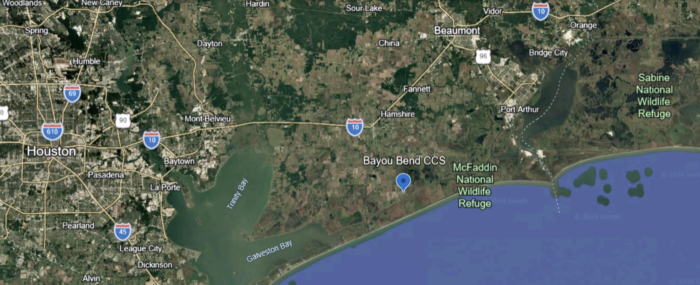
Bayou Bend CCS is located in Jefferson County, Texas
The deadline to sign up to address the commission on an agenda item or during public input is noon Mon, April 13th . (Note: They don’t have to call on you if you’re commenting on an agenda item).
People who want to speak on an item that is NOT on the agenda, must register to do so in the Public Input section. Note: you may not speak about an agenda item in the Public Input section.
RRC Open Meetings typically last less than half an hour.
Commission Shift’s Virginia Palacios will be giving public input in person. Following the open meeting at 2 p.m. CST, we’ll also host a virtual debrief of the meeting’s agenda items and related topics. You can join the zoom debrief here, or catch it streamed live on our Facebook page.