By Virginia Palacios
Commission Shift Executive Director
Two Texas Railroad Commissioners just made a move to censor the public at Open Meetings. The Railroad Commission of Texas (RRC) — which oversees oil and gas, not railroads — is already an opaque state agency. The latest “Public Engagement and Participation Policy” reduces opportunities for the public to speak directly to their elected commissioners.
I’ve been attending monthly Railroad Commission Open Meetings for the past five years. I give public input at almost every Open Meeting. Commission Shift has been advocating for the Railroad Commission to allow more public participation at Open Meetings by letting people give remote public input by phone or video conference, just like the Texas Commission on Environmental Quality (see TCEQ Commissioner’s Agendas, then “Registration Form.”)
At the August 18th Open Meeting, Railroad Commissioner Wayne Christian introduced a new public input process. Neither Commissioner Christian or then-Chairman Wright read the policy proposal out loud before they voted for it. Commissioner Craddick, now the new Chairman of the RRC as of the August Open Meeting, had the good sense to vote against the proposal.
Commissioner Christian repeated many of Commission Shift’s arguments for remote public input and changing the name of the RRC when he introduced the proposal, making it seem like he was offering more public participation, not less. But the new policy does more to distance the public from the Railroad Commissioners and the decisions they make, and it does the opposite of what Commission Shift has proposed.
I’ll break down the new policy here so you can see why Commission Shift is concerned, and why we’re not falling for Commissioner Christian’s “double-speak.”
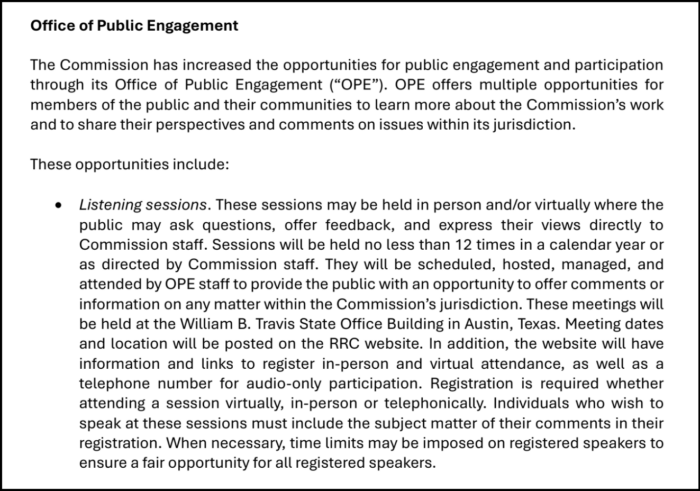
This and all images in this blog are from the Railroad Commission of Texas Public Engagement and Participation Policy.
The Railroad Commission started holding bi-monthly virtual listening sessions in November 2025.. These meetings are a positive step forward for public engagement at the Railroad Commission because they allow two-way dialogue between the public and RRC staff, and they allow impacted community members to understand RRC processes better and get answers to their questions. However, this was a staff-led effort, and while at least one Railroad Commissioner’s Chief of Staff attends every meeting, none of the Railroad Commissioners themselves are present
The new proposal makes these meetings more frequent and adds that they will be offered in-person in Austin as well. Making these meetings in-person in Austin does not add much for impacted community members, because there is no oil and gas development in Austin or Travis County. It would be more useful for the RRC to periodically host hybrid (e.g. in-person and virtual) listening sessions in oil and gas producing regions of the state.
More importantly, if RRC staff can host a hybrid listening session, they should be able to make remote public input available during RRC Open Meetings. Commissioners previously cited technical complications with hosting a hybrid meeting as an excuse for not allowing remote public input at open meetings. They must have found a way to solve that problem, so it is no longer a good excuse.
You may be asking why Commission Shift isn’t content with monthly hybrid listening sessions. It’s important to offer expanded public input opportunities at the open meetings themselves for several reasons:
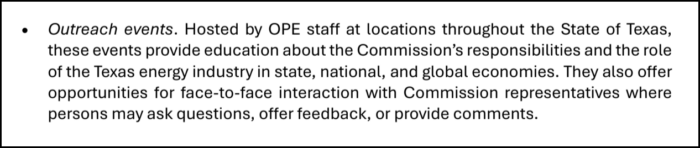
Commission Shift applauds the Office of Public Engagement (OPE) for the amount of public outreach they have conducted since they formed. However, there are some areas where we have hoped to see more.
First, the OPE has never been deployed to host in-district public hearings throughout the state to collect public comment on rulemakings. Giving general presentations about the RRC at public events and hosting public comments on rulemakings are two very different modes of public engagement. The Railroad Commission has not held in-district public hearings for rulemakings over the past several years, although this is something that the commission has done in the past (2002 and 2012 for updates to Statewide Rule 8 and Chapter 4, the waste management rules). Former staff in the OPE told me that the Hearings Division was responsible for hosting public hearings for rulemakings. I was also told that the Hearings Division likely didn’t have money for in-district public hearings. When I reached out to the Hearings Division this year to talk about the agency’s Legislative Appropriation’s Request (LAR), I was told that the LAR would be available to the public once it is approved and submitted. In other words, there wasn’t a transparent public comment process that would allow us to contribute suggestions to the agency-wide strategic plan or the LAR to solve the problem. This is just another example of how the agency is distancing itself from the public.
Next, the OPE previously asked Commission Shift to invite them to attend our public events or to hold meetings with some of the communities that have issues we’ve been raising in open meetings. We requested OPE’s participation in a recent event we held, and while the OPE told us they forwarded our request to commission leadership, we never received confirmation that RRC staff members would attend.
Along these lines, I gave public input at the April Open Meeting telling the story of another community that had requested an in-district meeting with RRC staff. They were not only denied a meeting, but were also told that they could only contact the RRC’s General Counsel from then on. Commissioner Christian defended his action to deny the meeting by claiming that individuals in the area had yelled at RRC staff in another in-district meeting. It’s important to understand that there is a difference between physical violence and yelling. Physical violence at a public meeting is unacceptable. Though not ideal, yelling at a public meeting is expected — especially when people’s lives, land, and water are threatened and the oversight agency isn’t doing enough to prevent it. You can watch the exchange between me and Commissioner Christian and learn more here.
To be clear, Commission Shift has had excellent experiences with OPE staff, who are kind, respectful, and hard-working. However, leadership seems to be getting in the way of a good idea and preventing OPE from doing their job. That’s part of why we aren’t giddy about the new policy — we’ll believe in expanded public engagement when we see it.
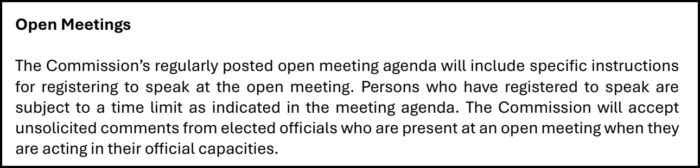
Nothing new here. The time limit for public input is typically three minutes. That amount of time is not specified in the new policy, and I wonder if the commission will make it shorter. In his remarks introducing the new policy at the August 18th Open Meeting, Commissioner Christian spoke about how much he didn’t like the time limit for public input, and he pitched the listening sessions as a venue where members of the public wouldn’t have a time limit. Nonetheless, listening sessions don’t provide the same opportunity as open meetings, because Railroad Commissioners don’t attend listening sessions.
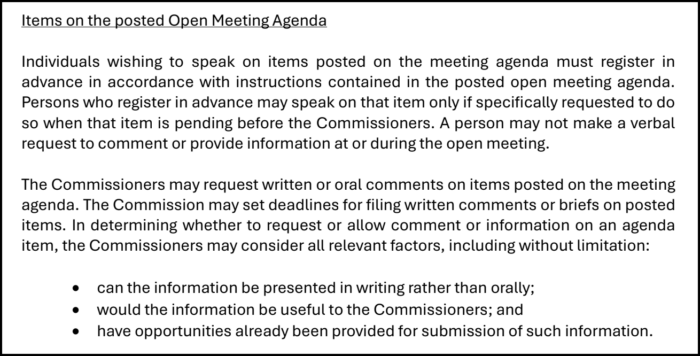
Public input has already been extremely limited at the RRC. You could sign up to comment on an agenda item, but the commissioners didn’t have to let you comment on it — and most of the time they don’t. The only times I have seen the Railroad Commissioners allow comment on agenda items is if a local elected official has signed up to speak.
This new policy puts in writing most of what we’ve already seen from the Railroad Commission when it comes to posted agenda items. The additional restriction is that the commissioners “may request” comments on agenda items, implying that they don’t have to receive any input unless it is requested in advance of the Open Meeting, adding more bureaucratic burden to the process. There may be good reasons for this clear procedure when it comes to contested cases, because the commissioners must avoid “ex-parte communications,” which means speaking to the parties in a contested case outside of the official hearings process. This applies to a few different types of official agency decisions, including, but not limited to: permit applications or renewals, enforcement actions, motions for rehearing, or formal complaints.
However, we also see the Railroad Commissioners exercising their authority to deny public comment on posted agenda items that never go through the Hearings Division and aren’t subject to an “ex-parte” restriction. This includes most of the items in the Administrative section of the RRC’s Open Meeting Agenda. At the August Open Meeting, the Administrative section included the new policy proposal. I signed up to comment on Item 884, “Proposal for Updated Public Engagement and Participation Policy,” and the commissioners denied my request to comment.
Commissioner Christian introduced the item without reading the policy out loud during the open meeting. Commissioner Craddick pressed Christian with questions about what the policy actually did. It seemed as though she and Commissioner Wright hadn’t seen the final draft before the meeting. To her credit, Craddick remarked “it says that we’re getting rid of our posting, our normal posting for public participation in our open meeting.” However she also added that “while I may not disagree that some people have abused the issue… I do believe some people wanna talk to us as commissioners and as elected officials. I think that’s something we ought to be open to.” (See transcript, Timestamp 00:58:00). Craddick ultimately voted against the policy, although the meeting recording and transcript did not capture her vote.
Side note: If I may be accused of abusing any privilege in my life, let it be my freedom of speech.
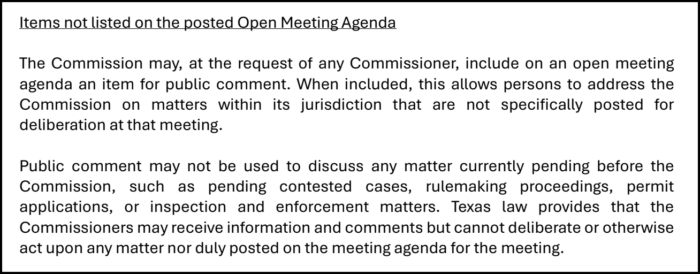
Before August 18, 2026, you had to sign up for public input, which takes place at the end of the RRC Open Meeting, to be allowed to address the commissioners at the meeting. You would only get three minutes to speak, and you were not allowed to speak about any posted agenda items. It wasn’t very open, and the new policy is even worse.
Adding bureaucracy, the new policy requires commissioners to request public comments be included as an agenda item, rather than the prior process, which automatically included public input on every open meeting agenda. This extra step means that the public is not guaranteed to have an opportunity to communicate with their elected representatives at every RRC Open Meeting.
This is bad, because if the commissioners don’t feel like listening to comments from people who disagree with them or have critiques of the agency, the new policy allows the commissioners to censor those people even more than they already did.
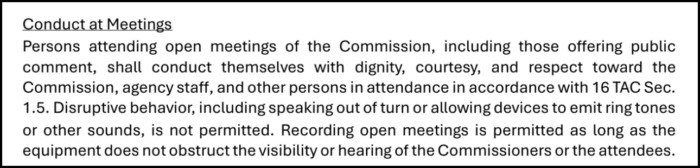
This is the same policy the RRC has already had, and it is reasonable enough.

There is a standard section of the RRC Open Meeting Agenda Notices titled “Auxiliary Aids or Services for Persons with a Disability,” which allows a member of the public to request ADA accommodations. This new policy could imply that the RRC will consider any type of language interpretation, not just sign language. The RRC has previously provided a Spanish interpreter at an RRC Open Meeting, and is increasingly providing interpretation services at rulemaking public hearings. We appreciate those advances at the commission, and we hope that the new policy means that the RRC will provide language interpretation for multiple languages.
In previous open meetings, Railroad Commissioners argued that remote public input is unnecessary because the commissioners are available to meet with people virtually outside of open meetings. I have sent emails, called, and left voicemails to request meetings with commissioners, and my messages were either not returned or I was directed to meet with the commissioner’s staff. I’ve only met with one commissioner so far.
Scheduling separate, personal meetings with commissioners is not a good substitute for allowing in-person or remote public input at open meetings.
Open meetings should be open. For too long, the Railroad Commission of Texas has operated in obscurity thanks to its inaccurate name and restrictive public participation policies.
Truly open meetings at the RRC would at least include:
More broadly, there are a few details of the open meetings that would reduce bureaucracy and make the meetings more accessible.
The Texas Legislature is responsible for overseeing the activities of state agencies like the RRC. The Texas House Governmental Oversight Committee has a hearing scheduled on the Open Meetings Act next Wednesday, August 26th. The Texas House Energy Resources Committee also has a hearing scheduled on Railroad Commission oversight on Tuesday, September 15th. Sign on to our letter to let them know what the RRC is doing — and make it clear that open meetings should be open.
Sign On