Commission Shift Statement on the End of the 2021 Regular Legislative Session


Virginia Palacios
Executive Director, Commission Shift
This is part 3 of our blog series about the anniversary of Winter Storm Uri. Read Part 1 here, and read Part 2 here.
Energy Transfer, a transmission pipeline company, was the single largest beneficiary of 2021’s Winter Storm Uri, raking in $2.4 billion in a matter of days. (1) State legislators and Railroad Commissioners chose to pass these extraordinary costs on to the general public. Campaign donations and personal financial interests held by these public officials raise concerns about whether state officials prioritized the public’s best interests after the storm.
Whereas regulators capped market-based electricity prices in Texas at $9,000 per Megawatt-hour, (2) they have never placed a cap on the price of natural gas in an emergency. With record-breaking demand for electricity and natural gas during the storm, natural gas prices soared. In theory, higher prices would motivate electricity generators to produce more power for the grid, but too much broken infrastructure made it impossible to get more gas to power plants, or to get the power plants online.
Nonetheless, everyone who pays a utility bill in Texas is now stuck with a higher bill for up to 30 years due to costs from the storm being securitized. (3) Securitization is a fancy way of paying off debt that costs more for people who owe the debt, but makes the debt an attractive “product” for an investor to hold for a period of time.
Securitization is a way of packaging and selling debt so that it can be paid off over a long period of time. Essentially, a financial institution can take the debt and sell it as a product, in this case a bond. As long as the debt has some type of collateral backing it, ensuring that a creditor can recover value if the debtor fails to pay, an investor might be attracted to buy the debt and get paid back later. In this case, the collateral comes from Texas taxpayers. If enough ratepayers stop paying their electricity bills, then the state of Texas will have to pay back the investors for the debt. When debt has collateral backing it, it is considered “secure” and less risky for an investor to purchase. To sweeten the package, the investors also get paid back with interest.
Here’s what happened during Winter Storm Uri and how securitization is increasing our energy bills.
Most Texans heat and power their homes with energy coming from one or both of two sources: electricity and natural gas.
On the electricity supply chain, in most parts of Texas, there are three entities involved: electricity generators (power plants), investor owned utilities (IOUs; i.e. lines and wires), and retail electric providers (REPs). The company most Texans buy their electricity from is the REP, who buys the electricity from the generators for the lowest cost possible. Some might know about their IOU, but the everyday renter probably doesn’t, because the IOUs take care of infrastructure like poles and wires that most people don’t have to think about unless they’re homeowners.
When electricity prices soared during Winter Storm Uri, REPs incurred $2,115,700,000 in debt that they would have to pay back to the generators. (4,5) , Another $800,000,000 was securitized for generators and REPs to pay back the Electric Reliability Council of Texas (ERCOT). (6) The Texas Legislature could have decided not to pass that debt on to “ratepayers” (customers who pay electricity bills). They could have recognized that the price of electricity was left at the cap for too long, and that leaving it at the cap did not motivate generators to put more power onto the grid, because the generators physically could not do that. But the legislature instead decided to securitize the debt. (7)
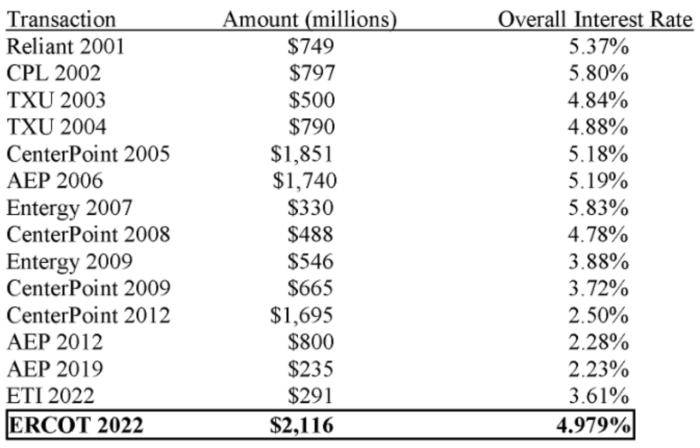
Amount of debt securitized, by electric utility (Tietjen, 2022)
On the natural gas side, transmission pipeline companies sell gas to end users like 1: local distribution companies that deliver gas via pipeline directly to homes or businesses, 2: power plants, and 3: industrial facilities.
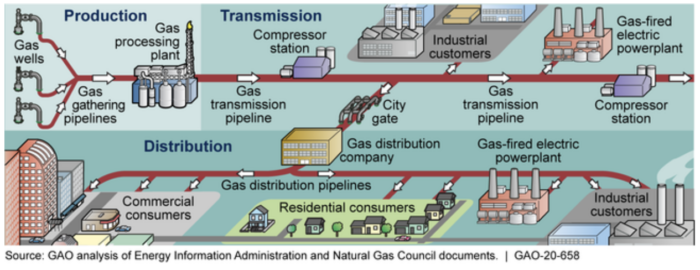
The Natural Gas Supply Chain
Unlike the electricity market, there is no cap on the price of natural gas. During the storm, when natural gas prices skyrocketed, electric power plants had to accept the extraordinary costs or they would fail to produce electricity. Therefore, some of the costs that now make electric bills higher are related to the uncapped price of natural gas.
Natural gas distribution companies also had to accept extraordinary debt to meet the emergency demand. People who pay both a natural gas utility bill and an electricity bill are now paying more on both of those bills.
The total debt incurred on the natural gas supply chain was $3,521,750,000, not including most of the interest that will be earned on the debt. (8) 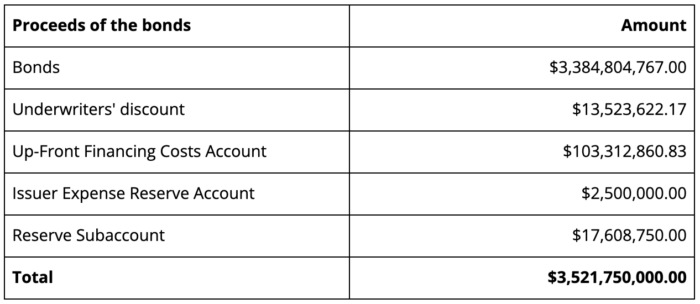
A breakdown of the total securitized debt on the Natural Gas Supply Chain. (Adapted from Texas Natural Gas Securitization Finance Corporation)
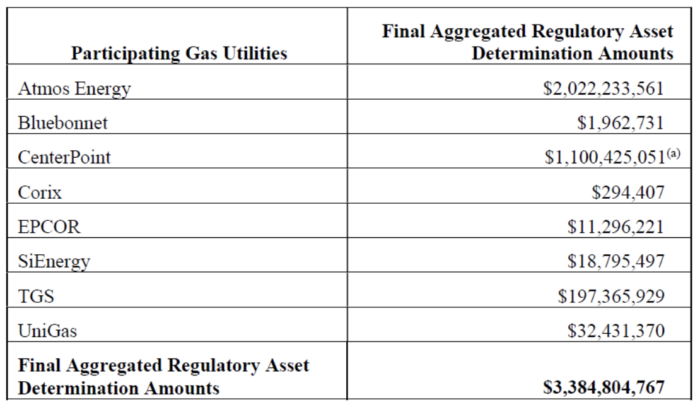
Amount of bonded debt, by natural gas utility. (Source: Texas Natural Gas Securitization Finance Corporation)
Similar to the electricity side, the Texas Legislature could have paid down some of the debt using the expected $725 million surplus they had available in 2021, or the $33 billion surplus they had available in 2023, but instead they decided to pay out the gas transmission pipeline companies by securitizing the debt. The Railroad Commission of Texas also voted on securitization. They could have declined or adjusted rate increases for customers, but they went right along with the Texas Legislature and approved the bonds.
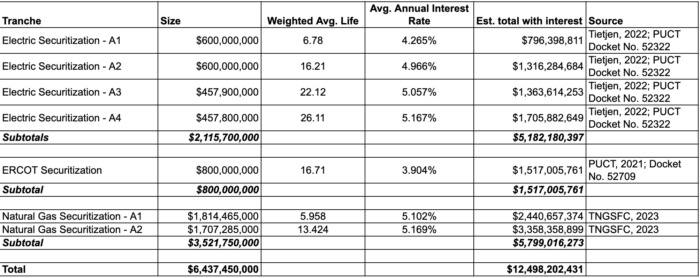
Total securitized debt from Winter Storm Uri
Texas lawmakers and Railroad Commissioners like securitization because they can frame it as a way to make electricity and natural gas bills more affordable, even though it actually increases our bills. They claim that if they didn’t allow for securitization, ratepayers would owe all $6.4 billion upfront. Instead, securitization has allowed the debt to be paid back over 30 years, in a much more manageable amount for the monthly utility bill ratepayer. But this perspective neglects the question of whether the costs were justified in the first place, and doesn’t consider the added expense of interest payments.
A household’s “energy burden” is the percentage of household income spent on energy bills, such as electricity or natural gas bills. The general rule of thumb is that utility bills should be 6% or less of household income to be considered “affordable.” The Texas Energy Poverty Research Institute just released a study finding that the average household electricity bill in Texas went up 30% since 2021, “adding $35–$40 per month to the typical [Low to Moderate Income] household bill.” These increases are primarily driven by upgrades to transmission and distribution lines needed for storm hardening, but securitization costs also influence them to some extent.
The Texas Legislature passed a broader policy in 2025 giving electric utilities the authority to issue bonds related to extreme weather events as needed. This means that increasing energy bills could loom for Texans as our weather becomes more extreme in both winter and summer.
If Texas legislators and Railroad Commissioners were more concerned about their constituents than their campaign donors, they might have made different choices in 2021. They might have demanded that natural gas transmission companies only recover absolutely essential costs, and only allowed a reasonable profit margin. They might have done the same for electricity costs.
Texans need to support more market oversight at the Railroad Commission of Texas and at ERCOT. Some groups have proposed more coordination between ERCOT and natural gas producers, by having a “gas desk” at ERCOT. Others proposed the need for an Independent Market Monitor for natural gas.
If we really want to be able to relax the next time Texas expects extreme cold or heat, we have to strive for a reliable grid. Having a reliable grid requires better oversight mechanisms and legitimate, enforced ethics rules.
______
1. Bloomberg. May 6, 2021. “Energy Transfer Made $2.4 Billion From Texas Winter Storm,” accessed January 27, 2026, https://www.bloomberg.com/news/articles/2021-05-06/energy-transfer-made-2-4-billion-gain-from-texas-winter-storm .
2. Anodyne Lindstrom and Alex Gorski, “Average Texas Electricity Prices Were Higher in February 2021 Due to a Severe Winter Storm,” EIA Today in Energy, May 7, 2021, https://www.eia.gov/todayinenergy/detail.php?id=47876 .
3. PUCT. (2022, June 9). Final Issuance Advice Letter for Subchapter N. Bonds.
https://www.ercot.com/files/docs/2022/06/17/FinalIssuanceAdviceLetterSubchapterN.pdf
4. PUCT, 2022.
5. Tietjen, D. (2022, June 10). Docket No. 52710 – Compliance Filing for Docket No . 52322, Public Utility
Commission of Texas. https://interchange.puc.texas.gov/Documents/52710_4_1214587.PDF
6. PUCT. (2021, Nov). Final Issuance Letter for Subchapter M. Bonds.
https://interchange.puc.texas.gov/Documents/52709_4_1165998.PDF
7. An Act Relating to Financing Certain Costs Associated with Electric Markets; Granting Authority to Issue Bonds; Authorizing Fees., HB 4492, Texas Legislature 87R (2021), https://capitol.texas.gov/BillLookup/Text.aspx?LegSess=87R&Bill=HB4492.
8. Texas Natural Gas Securitization Finance Corporation Customer Rate Relief Bonds (Winter Storm Uri), Taxable Series 2023. March 9, 2023. Cited in Robbins, Paul. Sep. 29, 2023. Paying the Gas Bill…for the Next 16 Years. Retrieved from: https://austin.environmentaldirectory.info/paying-the-gas-bill-for-the-next-16-years/
9. Texas State Comptroller, cited in Zelma Smith, 2022-2023 State Budget (Texas Association of Counties, 2022), https://www.county.org/resources/resource-library/legislative/county-legislative-issues/2022-2023-state-budget.
10. Brynne Harder, Inside the State’s Record Revenue (Texas Comptroller of Public Accounts, 2023), https://comptroller.texas.gov/economy/fiscal-notes/archive/2023/may/bre-line-item.php.
11. An Act Relating to Certain Extraordinary Costs Incurred by Certain Gas Utilities Relating to Winter Storm Uri and a Study of Measures to Mitigate Similar Future Costs; Providing Authority to Issue Bonds and Impose Fees and Assessments., H.B. 1520, Texas Legislature 87R (2021), https://capitol.texas.gov/BillLookup/History.aspx?LegSess=87R&Bill=HB1520.
12. Admin Monitor. Feb. 8, 2022. Railroad Commission of Texas Open Meeting. Retrieved from: https://www.adminmonitor.com/tx/rrc/open_meeting/20220208/
13. Mohammad N. Alkhatib et al., Ercot Electricity Affordability Outlook: Forecasting Residential Electricity Prices And Burdens (2025-2030). (Texas Energy Poverty Research Institute, 2025).
14. Alkhatib et al. (2025)


Commission Shift Statement on the End of the 2021 Regular Legislative Session