Commission Shift Statement on the End of the 2021 Regular Legislative Session


Virginia Palacios
Executive Director, Commission Shift
Every winter storm we’ve had since 2021 has been compared to Winter Storm Uri, but none have been as severe. It’s important to remember that the 4.5 million power outages Texans faced in Winter Storm Uri caused hundreds of deaths, influenced the largest carbon monoxide poisoning event in state history, and was one of the costliest natural disasters in state history. People want to know: what’s different about this year’s winter storm? Is the grid safer? Did the laws we changed following the 2021 grid catastrophe work?
Not every question has an easy answer. Despite emphatic reassurance from politicians about the grid being better than ever, we know from experience that we have to take a sober look at the data to see the full picture. The power plant outages we’ve seen so far during Winter Storm Fern have been minor compared to Winter Storm Uri, but they still show that we need stronger oversight at the Railroad Commission (RRC), our state oil and gas agency, to keep the heat on.
We have more electricity generation capacity on the grid than ever before. In the months preceding Winter Storm Uri, ERCOT’s Seasonal Assessment of Resource Adequacy (SARA) expected 82 gigawatts (GW) of power to be available to meet peak winter demand.(1) In November of 2025, ERCOT estimated 99 GW of expected available capacity for January 2026, and 183 GW of installed capacity.(2) Most of the capacity additions came from new wind, solar and battery storage facilities.(3)
In 2021, temperatures across the state dropped below freezing for multiple days between February 8th and 20th.(4) The freezing temperatures over multiple days caused natural gas wells to freeze over and components on pipeline compressor stations to fail. Oil and gas formations contain naturally-occurring water that is produced along with oil and gas from the wellhead. When that water made it to the surface, it froze, restricting gas flow and preventing fuel from reaching natural gas-fired power plants. At the time, natural gas-fired power plants provided more than 70% of power on the grid.(5) Today they make up 60% of expected capacity.(6)
We might be safe from key failures on the grid again, because of laws passed by the Texas Legislature requiring critical natural gas infrastructure to be weatherized. Over 900 people commented on and strengthened rules introduced by the Railroad Commission to implement these laws. But gaps remain in how the rules are enforced, and oil and gas industry players consistently lobby to weaken them.
For example, a report from the state auditor’s office revealed that Railroad Commission inspectors counted any form of weatherization as “passing,” and did not assess the adequacy of oil and gas operators’ weatherization efforts.(7) When the weatherization rule was developed in 2022, the initial draft included specific measures operators would have to implement, but those were struck from the final version of the rule because operators argued that putting the specific measures in a guidance document would “afford the Commission greater ability to communicate changing technology or practices.” The problem is that the lack of specificity has led to operators taking the lowest-cost route to compliance, which may not actually keep gas flowing when we have another storm as severe as Winter Storm Uri.
Each year, the Railroad Commission hosts an “RRC Regulatory Conference” to educate operators about how to comply with agency rules. Every time I have attended the conference sessions about weatherization, without fail, an operator asks why these rules exist and complains about the expense of compliance. Thankfully, the importance of the rules is not lost on Railroad Commission staff, who have reminded the attendees of the hundreds of lives that were lost during Winter Storm Uri.
There are two rules that operators have to know to follow the weatherization requirements: 3.65 Critical Infrastructure Designation and 3.66 Weatherization. Operators only have to comply with the weatherization rule if they are designated as “critical infrastructure.” Several different types of facilities are named as “critical infrastructure” in the rule. Importantly, when it comes to oil and gas wells, only gas wells producing more than 250 thousand cubic feet (Mcf) of gas per day and oil wells producing more than 500 Mcf per day are considered critical. Although 250 Mcf is enough gas to power a home for a day and a half, many operators have complained that even 250 Mcf is such a small amount of gas that they shouldn’t be required to weatherize.(8) But even what operators might claim is “low production” can contribute to keeping the power on during a weather emergency, which can save lives.
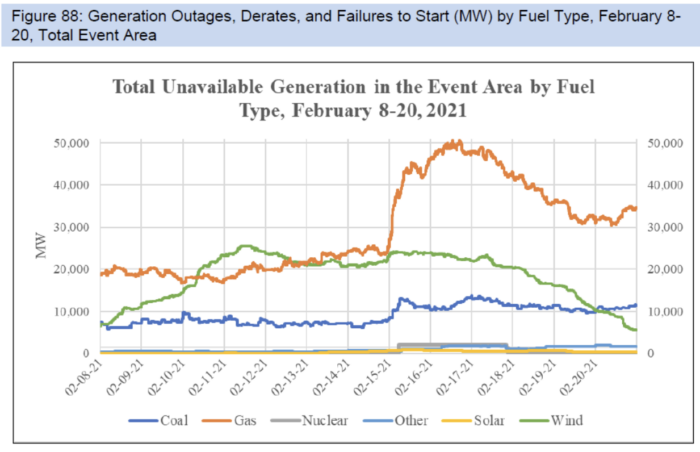
It’s difficult to say whether the Railroad Commission’s implementation of the new rules passed in 2021 and 2022 has gone far enough to protect us from the same kind of deadly power outages we saw during Winter Storm Uri. This year’s Winter Storm Fern and the other winter storms we’ve experienced since Uri haven’t come close to the intensity and duration of Uri. In 2021, the total unavailable power generation attributed to natural gas power plants reached about 50 GW at its peak.(9) This week, forced outages from dispatchable plants (including but not limited to natural gas) peaked at about 13 GW.(10)
ERCOT’s Unplanned Resource Outages Report shows that natural gas-fired power plants experienced forced stoppages related to fuel supplies, causing reduced power availability of 0.9 GW between January 22, 2026 and February 6, 2026. Meanwhile another 3.9 GW were down for reasons listed as “other,” which could include fuel supply issues. Although less disastrous compared to Winter Storm Uri, these forced outages show that we still have changes to make to build a truly resilient grid.
Stay tuned for our next blog about Winter Storm Uri: The Railroad Commission still has a role to play to strengthen the grid – what are the solutions?
______
1. ERCOT. Nov. 5, 2020. Final Seasonal Assessment of Resource Adequacy for the ERCOT Region (SARA) Winter2020/2021. https://www.ercot.com/files/docs/2020/11/05/SARA-FinalWinter2020-2021.pdf
2. ERCOT. Nov. 7, 2025. Monthly Outlook for Resource Adequacy (MORA) Reporting Month: January 2026. Accessed on: January 26, 2026. Retrieved from: https://www.ercot.com/files/docs/2025/11/07/MORA_January2026.pdf
3. ERCOT. June 2025. ERCOT Monthly. Accessed on: January 26, 2026. Retrieved from: https://www.ercot.com/files/docs/2025/08/06/ERCOT-Monthly-July-2025.pdf
4. Federal Energy Regulatory Commission and North American Electric Reliability Corporation, The February 2021 Cold Weather Outages in Texas and the South Central United States (2021), https://www.ferc.gov/media/february-2021-cold-weather-outages-texas-and-south-central-united-states-ferc-nerc-and.
5. ERCOT. Nov. 5, 2020. SARA Winter2020/2021.
6. ERCOT. Nov. 7, 2025. MORA January 2026.
7. Mose Buchele, “Texas Promised to Winterize Its Energy Grid. An Audit Found Big Problems.,” Energy & Environment, KUT Radio, Austin’s NPR Station, August 18, 2025, https://www.kut.org/energy-environment/2025-08-18/texas-energy-grid-winterize-blackouts-audit.
8. According to the U.S. Energy Information Administration, average monthly energy consumption for a household in Texas was 1,096 kWh in 2024. And 7.4 cubic feet of natural gas were needed to produce one kWh of electricity in 2022.
9. FERC, 2021.
10. ERCOT. January 26, 2026. Unplanned Resource Outages Report. Retrieved from: https://www.ercot.com/mp/data-products/data-product-details?id=NP1-346-ER


Commission Shift Statement on the End of the 2021 Regular Legislative Session