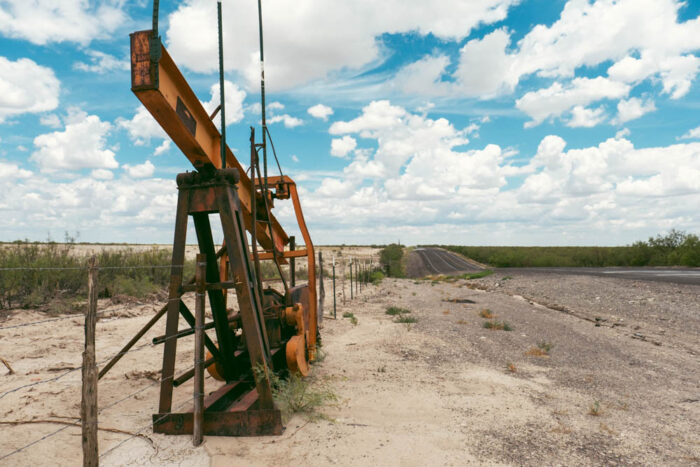
At the June 2nd Open Meeting of the Railroad Commission of Texas, Commission Shift Executive Director Virginia Palacios spoke about the overflow of a sinkhole in Kelton Ranch and provided recommendations for how to address the growing number of emergency incidents in the Permian Basin.
View a written copy of Virginia Palacios’s public comments here.
Other concerned community members also gave public comments at the open meeting. View their input below.
Carolina Bustos, The Raices Collab Project
Schuyler Wight, rancher and landowner
Alexander Spike, Climate Justice Coordinator, Air Alliance Houston
The Railroad Commission (RRC) permits, monitors, and enforces rules for all Texas oil and gas development. RRC decisions are critical to public health and climate emissions, yet the agency operates with little public accountability. For instance, the three elected Commissioners have deep financial ties to the industry they regulate, with two-thirds of their campaign contributions coming from oil and gas.
The RRC holds monthly open meetings. While challenging to follow, the open meetings are a valuable opportunity to get issues on the record and learn more about decisions that affect us and our communities.
The open meeting agenda for June 2nd, 2026 at 9:30 AM is available.
Below are our agenda highlights with some additional notes and context.
Critical Infrastructure Division
Item 7. Troubadour Operating, LLC requested a motion for rehearing, claiming it didn’t receive notice of a default judgement from the RRC due to the company’s failure to file forms that designate its facilities as critical infrastructure. Companies that are designated as critical infrastructure have to follow weatherization requirements. RRC staff will recommend denial of Troubadour’s request, and the company will be penalized $1,000.
Examiner’s recommendation approved.
Oil & Gas
Item 9. RRC issued a “No Harm” Letter to Southwestern Electric Power Company (SWEPCO) – indicating that its Class I “non-hazardous” waste disposal well will cause no harm to neighboring oil, gas, or injection wells. Valence Operating Co. asked RRC to rescind the letter because it has oil and gas wells within the 2.5 mile area of review of the proposed Class I well. RRC are denying Valence Operating’s request because Valence’s wells are not within the same injection interval as the proposed SWEPCO well.
Commissioner Wright moved to approve the examiner’s recommendation.
Commissioner Christian refused to second the motion.
The commissioners decline to hear comment from the parties present.
Commissioner Craddick seconds the motion and the motion passes.
Item 10. Company officers Carrell and Nerren sold their business, including an oil and gas separating facility, to three people named Delgado, Griffin, and Scirone (“DGS”). DGS failed to update the P-5 Organization Report with their names, which gives them authority to operate in Texas. Carrell and Nerren filed a complaint with the RRC to force DGS to file an amended P-5 removing Carrell and Nerren as officers responsible for the facility. RRC is requiring DGS to file an amended P-5 for the facility. There are a few interesting points in this case:
Examiner’s recommendation approved.
Items 11 – 31. Trivista Operating LLC applied for authority to “swab” its oil wells for 24 wells in Lee County. Swabbing is a method that uses cups dropped down into the well to remove fluids from the well manually, in order to reduce pressure and get oil to flow from the well. RRC staff are recommending denial of Trivista’s request because they do not have a good faith claim to operate the wells.
The Hearings Division asked to pass the items to the next conference.
Trivista also has items 48 and 49 on this agenda:
Item 48. A mineral owner in Bastrop County filed a complaint that Trivista Operating LLC does not have a good faith claim to operate his lease. Trivista was also illegally swabbing his wells. RRC is recommending the commission find that Trivista does not have a good faith claim to operate, order any plugging extensions canceled, and order Trivista to plug and abandon the well and lease.
Examiner’s recommendation approved.
Item 49. Trivista Operating applied for unrestricted renewal of its P-5 Organization Report, which gives it authority to operate in Texas. RRC had already determined that the P-5 couldn’t be renewed because Trivista did not plug its wells or request plugging extensions from the RRC. In April, Trivista claimed that it “underwent a complete change in ownership and management, applied for bankruptcy protection, and [had] taken steps toward regulatory compliance,” and that the new owner wasn’t aware of the notice of deadline the RRC previously sent. RRC staff said the new owners aren’t listed on any commission filings, and find that Trivista’s motion fails to meet any prongs of the Craddock test. RRC staff recommend the motion for rehearing be denied. Based on this decision, Trivista will lose its authority to operate in Texas and its 69 inactive wells will be orphaned.
Examiner’s recommendation approved.
Items 32 – 35. RRC staff are recommending denial of well transfer applications from Vision Oil and Gas LLC to D&D Well Service LLC. D&D said they had all the documentation to establish a good faith claim to operate the leases, but didn’t provide that evidence to the RRC. RRC says the company failed all three prongs of the Craddock test, and is denying D&D’s motions for rehearing.
Examiner’s recommendation approved.
Items 36 – 45. RRC staff are recommending denial of well transfer applications from O&O Operating LLC to Vision Oil and Gas LLC for leases operated in Pecos County. Vision filed 10 P-4s, and RRC requested a good faith claim review. The company had 20 days to respond to the request, but failed to do so. RRC says the company failed all three prongs of the Craddock test, and is denying Vision’s motions for rehearing.
Examiner’s recommendation approved.
Items 46 & 47. Sozo Natural Resources filed a complaint against Solaris Water Midstream LLC for its Class II waste water disposal permits. Sozo claims Solaris did not mail Sozo notice of the permit applications. Solaris says it mailed the permits with notice to Sozo, but Solaris did not use certified mail. Furthermore, notice was not required to be sent to Sozo, because it was an offset operator slightly outside the half-mile radius area of review for a Class II well. RRC staff are recommending dismissal of Sozo’s complaints.
Examiner’s recommendation approved.
Items 50 – 63 are motions for rehearings. In past meetings, the Railroad Commission voted to revoke their operating authority for failing to keep their inactive wells compliant. These operators requested rehearings to buy more time to continue operating, but these motions are seldom granted. These 13 operators will orphan 351 inactive wells in the state if they lose their motions. Over 70% of these wells have been inactive for more than 5 years, and statistically, had less than a 15% chance of ever returning to production. Operators could have plugged these wells when they stopped producing if we had required it, but now these costs will fall to Texas.
Items 51-63 approved. Dropped to 141 inactive wells due to operator attempts to bring wells into compliance.
There are five flaring rule exception requests on the agenda. Four of these are requested by CPX Energy Operating, LLC in the Phantom (Wolfcamp) Field in Loving County. CPX Energy was granted four other flaring exceptions last Fall. Operators flared an estimated 180 to 200 billion cubic feet of gas in the Permian Basin in 2025, enough to supply 3.2 million homes with natural gas for an entire year. Pipeline capacity often limits the amount of gas operators sell, but if flaring exceptions are automatically granted, operators have little incentive to build out that capacity.
Twenty-five companies appear to be out of compliance with Rule 15 inactive well requirements. RRC can prevent them from operating in Texas until they comply, which may include plugging or removing surface equipment. Twenty-four of these companies have a total of 284 inactive wells.
One operator not included in the count is R2Q Operating, LLC. It has produced 62,000 barrels of oil in the past 12 months from its operational wells, according to onevalor.com. But carrying a large number of inactive wells carries significant risk for mid-size operators like R2Q Operating. Over 60% of its 937 inactive wells have been inactive for over 10 years, and the cost of addressing failures for failed mechanical integrity tests may weigh down the balance sheet and cause a company to fail. They might correct the issues that caused it to fall out of compliance, but as the well population ages, maintaining compliance for a large population of inactive wells can eventually catch up with a company.
Pass on items 111 – 119. Items 97 – 110 approved. 208 wells in the items approved.
Item 342. The commissioners will approve the Strategic Plan for Fiscal Years 2027-2031. The agency’s strategic plan is used to develop its Legislative Appropriations Request for the next biennium, 2028 – 2029.
Approved.
Item 343. Commissioners will vote to approve the Fiscal Year 2027 Oil and Gas Monitoring and Enforcement Plan. The Plan must be approved by Jul 1, 2026 each year. This year, Commission Shift collected over 350 sign-ons and comments to strengthen the plan. Commission Shift’s comments can be found here. After the plan is approved, the RRC plans to translate the plan into Spanish before publishing it on their website.
Approved.
The deadline to sign up to address the commission on an agenda item or during public input is noon Mon, June 1st. (Note: They don’t have to call on you if you’re commenting on an agenda item). Instructions for registering to give input can be found at the top of the RRC’s agenda for the open meeting.
People who want to speak on an item that is NOT on the agenda, must register to do so in the Public Input section. Note: you may not speak about an agenda item in the Public Input section.
RRC Open Meetings typically last less than half an hour.
Commission Shift’s Virginia Palacios will be giving public input in person. Following the open meeting at 3 p.m. CST, we’ll also host a virtual debrief of the meeting’s agenda items and related topics. You can catch it streamed live on our Facebook page.